
There is something particular about September.
The calendar does not begin again. There is no midnight countdown, no fireworks, no official invitation to decide that tomorrow everything will be different.
And yet, for many of us, September feels more like a new beginning than January ever does.
We buy a new notebook. Clear our desks. Reopen our calendars. Return to movement. Pick up a book. Suddenly, we want to declutter the wardrobe, the house, our phones, our schedules — sometimes even our relationships.
September carries a particular psychological charge. For many people, it is not merely the ninth month of the year but a second opportunity to begin: summer recedes, routines return, academic and professional rhythms intensify, and the remaining months of the year invite us to look backward and forward at the same time.
There is psychological logic behind that feeling.
And questions begin to surface.
Where am I?
How do I actually feel?
Is this how I want to continue?
What am I missing?
And what do I no longer need?
Perhaps September is not simply the beginning of another season.
Perhaps it is an invitation to return to ourselves.
The psychology of a second beginning
Psychology has a name for our attraction to moments like this: the fresh start effect.
Research by Hengchen Dai, Katherine Milkman and Jason Riis found that people become more likely to pursue aspirational behaviours after meaningful temporal landmarks — the beginning of a year, month or week, a birthday, a holiday or the start of a new academic period. These landmarks create a psychological line between before and after.
September is full of these associations.
For many of us, September has meant beginning since childhood.
A new school year. New notebooks. New schedules. New classes. A new season.
Decades after our last first day of school, part of us may still recognise September as a time to organise, move and begin.
But there is another reason this month feels different.
September arrives after a pause.
And pauses change perspective.
Summer is not empty space
Summer tends to loosen our routines.
The days stretch. We spend more time outside. We travel. Eat differently. See different people. Sit around tables for longer. Look at the sea. Walk barefoot. Read. Sleep.
Or, at the very least, we spend a little less time measuring every hour according to how productive it has been.
Something important happens in that space:
a little distance appears between us and our ordinary lives.
And from that distance, we begin to see.
The job we do not want to return to.
The habit we did not miss.
The person we want more time with.
The conversations that leave us depleted.
The mornings we wish could remain slower.
The project that keeps returning to our thoughts.
The body that has been asking us to rest.
Let's frame rest not as a reward for having done enough, but as something necessary for clarity and purposeful action. Rest includes intentional pauses, breathing, time away from technology and walking — small ways of creating enough quiet to hear ourselves again.
Perhaps that is why we do not return from summer entirely unchanged.
Rest does more than restore energy.
Sometimes it restores our ability to notice.
The body knows the season is changing too
Autumn does not happen only on a calendar.
Daylight gradually decreases. Temperatures shift. Daily routines change. Light is one of the important signals through which our bodies regulate circadian rhythms, and seasonal differences can influence patterns of sleep, energy and mood.
Add to that the return of work, school, traffic, responsibilities, schedules and more hours indoors.
September can therefore hold two apparently opposite experiences at once:
energy and fatigue;
inspiration and anxiety;
the desire for change and resistance to it.
There is nothing unusual about that.
Transitions often contain two movements: one part of us wants to move forward while another has not completely left where it was.
A psychosomatic perspective can be useful here — without turning every physical sensation into a psychological explanation.
Instead of only asking:
“What is wrong with me?”
we can sometimes add:
“What am I experiencing?”
Fatigue may invite us to reconsider our pace.
Tension may encourage us to notice accumulated stress.
Restless sleep may be a reason to examine our rhythm.
Irritability may tell us that our resources are running low.
The body does not always carry a hidden symbolic message.
But it always deserves to be listened to.
Not “What should I achieve?” but “What do I need?”
This is where the September reset can easily become another trap.
New goals.
New diet.
New routine.
New workout.
New project.
New morning ritual.
Suddenly, our fresh start has become another list of things we are failing to do.
Self-knowledge places at the centre of a fulfilling life: the better we understand who we are, the more reliably we can make choices about our work, relationships, friendships and personal goals.
So before setting goals for autumn, try something more radical:
decide nothing for a moment.
Sit.
Let it become quiet.
And ask:
How am I, really?
Not how should I be?
Not how does my life look from the outside?
Not what would be impressive to accomplish before December?
Just: How am I?
A September inner audit
Take a page and divide your life into a few areas:
body / work / relationships / home / time / creativity / money / inner world
For each one, complete three sentences:
More of…
Less of…
I want to keep…
For example:
More of — mornings without my phone.
Less of — meetings that could have been emails.
I want to keep — my summer evening walks.
That final sentence matters.
September does not have to mean shutting the door on summer and returning to our “serious” selves.
We are allowed to take something with us.
Which part of your summer self deserves to stay for autumn?
From goals to intentions
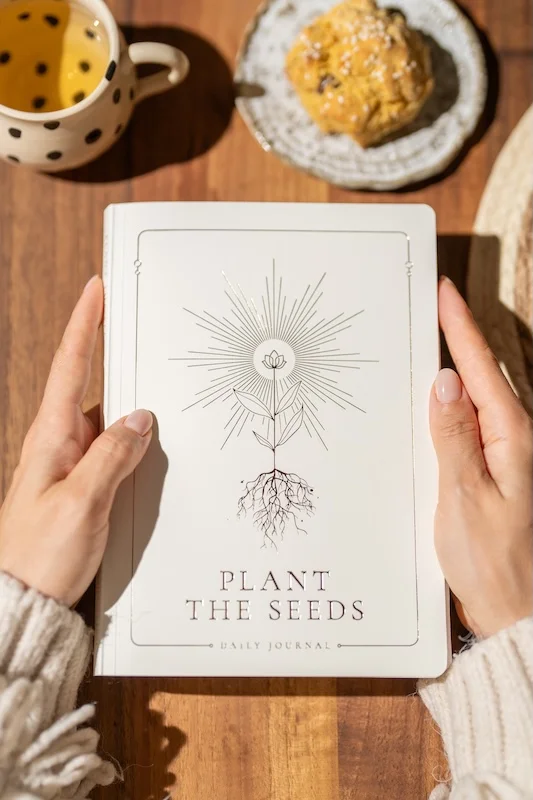
Plant the Seeds Project makes a useful distinction between rigid resolutions and meaningful intentions: reflect first, recognise what you have learned, then decide what genuinely matters now. Its journaling frameworks combine reflection with small actions and regular reviews rather than focusing exclusively on the final outcome.
So instead of:
“By the end of the year, I must…”
try:
“This autumn, I want to create more space for…”
The difference sounds small.
It isn't.
A goal asks:
Where do I need to arrive?
An intention asks:
How do I want to live while I am getting there?
Sometimes the second question changes the first.
Not every change requires more effort
A recurring theme in life-coahes' work is surrendering excessive control — noticing when action has shifted from clarity into pushing, forcing and trying to make life follow a predetermined script. Their practices encourage grounding, meditation, intention and returning to a more aligned next step.
This offers an interesting September question.
Perhaps the new season is not asking:
“What more can you do?”
Perhaps it is asking:
“What can you stop forcing?”
Sometimes growth is action.
Sometimes it is refusal.
Sometimes it is a boundary.
Sometimes it is rest.
Sometimes it is admitting that the goal we wanted in January no longer belongs to the person we have become by September.
That is growth too.
Ritual turns intention into life
Tony Robbins places considerable emphasis on rituals — the small, repeated behaviours through which intentions eventually become part of everyday life. His morning “priming” practice combines breathing, gratitude and visualisation to intentionally direct attention before the demands of the day begin directing it for us.
You do not need someone else's routine.
In fact, the Plant the Seeds philosophy suggests almost the opposite:
create a ritual that feels like you.
You do not need a perfect morning.
You need one small recurring moment in which you remember how you want to live.
Try the 3–3–3 ritual
3 minutes for your body
Breathe. Stretch. Step outside. Feel your feet against the ground.
3 minutes for your mind
Write down how you feel before checking how the rest of the world feels.
3 minutes for direction
Ask:
What is one thing that truly matters to me today?
Nine minutes.
Not to optimise your life.
To be present in it.
Five rituals for September
1. Choose a word for the season.
Not a goal. A word.
Space. Courage. Ease. Focus. Trust. Creativity. Presence.
When making a decision, ask:
Does this move me closer to my word?
2. Keep one summer habit.
The walk after dinner.
Coffee outside.
Swimming.
Reading before bed.
Less make-up.
Less rushing.
Do not let the calendar take away everything summer helped you remember.
3. Clear one space.
One drawer.
One shelf.
Your desktop.
Your calendar.
One commitment.
You do not need to organise your entire life to create a little more room.
4. Create one boundary.
One hour without your phone.
One evening without work.
One “no” you have been postponing.
One “yes” to something you have never made enough time for.
5. Turn Sunday into a meeting with yourself.
Just fifteen minutes.
How did I feel this week?
What gave me energy?
What took it away?
Where did I say yes when I needed to say no?
What do I need next week?
Messages for the new season
I do not have to start over. I can simply continue more consciously.
I am not rushing. I am choosing my direction.
I am allowed to change a decision that no longer fits who I am today.
Rest does not take me away from my path. It is part of it.
Not everything I am capable of carrying needs to be carried forward.
I leave room for life to surprise me.
I do not measure my growth only through results. I notice the way I live.
I am allowed to organise my priorities around my real needs.
I do not need to know the entire path. I only need to recognise the next honest step.
This season is not a promise to become someone else. It is an opportunity to become a little more myself.
21 Days: The Plant the Seeds September Reset
The next 21 days are not a challenge.
There is no streak to break.
There is no perfect score.
Every day does not have to be better than the one before it.
This is an observation practice.
Take a few minutes each day and notice four things:
Energy: 1–10
Satisfaction: 1–10
Connection with myself: 1–10
My small step today: one sentence
After 7 days
What gives me more energy than I expected?
What drains me?
Which small action would I like to repeat?
After 14 days
What am I beginning to understand about my needs?
Where do I feel more ease?
What am I still doing simply because I have always done it?
After 21 days
Do not look only at the numbers.
Read your words.
What changed?
What kept repeating?
When did you feel most like yourself?
What does your body need?
What deserves your attention?
What deserves a place in the season ahead?
Then complete one sentence:
From here, I want to give myself more…
Perhaps that is what September is really about.
Not beginning a new life.
Not fixing the old one.
Not becoming a more productive, disciplined or perfected version of ourselves.
But pausing long enough to recognise which parts of our lives still belong to us — and which ones we have quietly outgrown.
Nature does not enter autumn trying to hold onto every leaf.
Perhaps we do not need to either.
Some seasons are for becoming.
Some are for letting go.
And some are simply for returning to yourself.
Plant the seeds. Give them time. See what grows.